A White Paper on Workforce Succession
in Relationship-Driven Industries
The Leadership Valley
What the Gap Costs an HVAC Manufacturers’ Rep Firm
Prefer a PDF? Download a copy at the end of this page.
Executive Summary
The HVAC manufacturers’ rep industry is missing a generation. Professionals aged 35 to 50 — the next branch managers, sales VPs, and owners — are largely absent, creating a gap this paper calls the Leadership Valley. Manufacturers already know it. They evaluate a rep firm by who holds its relationships today and who will hold them in five years; they raise the question with principals directly; and they move lines when the answer is no one. The generation that built these firms, now aged 50 to 70, holds the client relationships that drive sales, and the manufacturer lines follow the people who hold those relationships. The cohort entering behind them, aged 20 to 35, is healthy but years from being ready. In between, the ranks are thin.
This paper documents the gap and traces its origins. More importantly, it lays bare what an unaddressed Valley costs, and what it takes to fix it.
The Valley has two causes, and neither is any one owner’s mismanagement. The first is external: the cohort now aged 35 to 50 graduated into the years when software and finance absorbed a rising share of the country’s engineering graduates, the same graduates this channel had always drawn its next leaders from. The pipeline did not run dry; it flowed elsewhere, and the channel’s share of each graduating class shrank. The second cause is internal, and it is the one rep firms control: where salespeople are on 100 percent commission, the firm pays for individual production and for nothing else, so it never produces a sales manager by accident. The channel neither attracted its share of a generation nor developed leaders from the share it did attract.
The Valley persists unless the firm acts to close it. The missing middle is where your next senior producers should be maturing and where your sales manager should be standing, and the two absences are connected: without a sales manager developing the team, your young reps never grow into your next senior producers. The timelines do not overlap, the incentives point the wrong way, and your senior reps were trained to sell, not to train. Left alone, it compounds — in departures, in line-card risk, and in the value of your firm.
The fix is structural, and it starts with two solutions that tackle the same two causes that created the Valley.
- The Account Continuity Agreement. Compensation redesign comes first. The Agreement pays a senior rep to release accounts, so that releasing an account builds their retirement instead of shrinking their paycheck. When the senior rep is also the owner, the same agreement decides what the firm is worth when the owner leaves. Hiring a producer puts someone in place to receive accounts; the Agreement is what makes a senior rep willing to release them.
- The hires. Where a firm cannot promote from within, it hires from outside; for a channel that did not attract its share of a generation, that is the direct answer.
- The sales rep hire: an experienced producer hired to take the accounts once the senior rep agrees to release them. There are three places to look.
- Another HVAC rep firm: the fastest way to generate revenue at an experienced rep level, but candidates are scarce, and non-competes make it costly.
- An adjacent industry: the most likely candidate. Expect that hire to master the line card in 12 to 18 months and sell at a veteran’s level in about three years.
- A graduate developed inside the firm: about five years.
- The sales manager hire: when the role does not exist, the firm creates it and fills it, most often from outside HVAC, where the leadership skills this channel does not teach are already built.
- The sales rep hire: an experienced producer hired to take the accounts once the senior rep agrees to release them. There are three places to look.
The fix costs real money, but it pays. Manufacturers judge a rep firm on continuity, and a buyer — increasingly a private equity platform — is simply that judgment with a checkbook. Make the fix, and it protects revenue measured in millions for an investment measured in hundreds of thousands.
The House You Built
You know this house. Maybe you built it; maybe your father or mother did. Solid bones, real character, a street where everyone knows your name. It has been kept with care, and the porch has seen 40 years of handshakes. Nothing about this house is neglected.
Except one thing. The roof. The one you’ve been telling yourself has five good years left, for about eight years now.
The HVAC manufacturers’ rep firm is that house.
It was built on something real: deep, personal relationships between the people who sell equipment and the engineers, contractors, and end users who specify and buy it. Those relationships are the foundation, and they are extraordinarily strong. A senior rep who has spent 25 years earning the trust of a mechanical engineer at a major design firm has something no competitor can replicate with a brochure or a price cut. That relationship is worth millions in annual revenue. That’s why the house is worth everything you’ve put into it.
This paper is not about a firm in disrepair. The firms we are describing are successful, profitable, and well run; that is precisely the point. But everything about the house sits under that one roof, and the problem with a deferred roof is not ignorance. You know. You keep meaning to get to it, and the longer it waits, the less certain you can be about what is happening underneath it.
The Leadership Valley
The Evidence
What manufacturers are watching
Start with the evidence that no one in this channel disputes, because every principal has lived it. Manufacturers evaluate their rep firms on one question: can this team specify and sell our products not just today, but five, 10, 15 years from now? Regional and national sales managers ask it in line reviews, when a senior rep retires, and when a competing firm in the territory hires someone young and capable. Principals hear it directly: how deep is your bench? Who is your successor on this account? What happens to our line when your senior rep is gone?
The reason is structural. A rep firm is the manufacturer’s local brand. The rep firm’s people build the manufacturer’s specification strength in a territory, one relationship at a time, and the manufacturer knows it can lose that position faster than it can rebuild it. A firm with no one between its senior reps and its youngest ones shows every manufacturer on its line card that it has no plan for who will carry the line after the seniors retire, whether the principal has said so or not.
The rep channel’s own institutions
The rep community’s own institutions document the Valley, starting outside HVAC. The National Electrical Manufacturers Representatives Association, the trade association for independent reps in the electrical channel, a business structurally identical to HVAC representation, devoted a substantial portion of its 2025 Rep of the Future report to exactly this issue. NEMRA identifies aging manufacturers’ rep leadership as a primary driver of channel change, reports that few new rep firms are being formed while more merge or are bought, and projects 25 percent fewer independent rep firms by 2030. The report is blunt about what is at stake with manufacturers: “An agency is as good as its people,” and manufacturers are continuously evaluating their rep partners on both today’s performance and tomorrow’s ability to perform.1
No one has published an HVAC-channel equivalent of NEMRA’s report. However, the HVAC rep channel’s own association points to the same gap: AIM/R, the Association of Independent Manufacturers’/Representatives, has built a next-generation leadership program, Leaders of Tomorrow... Today, and offers succession-planning programming to its member firms, whose ranks include the HVAC rep firms this paper is about.2 A program to develop a next generation of leaders exists because the current generation is not being replaced from within.
The broader picture of the independent rep firm tells the same story. The most detailed profile we found of the typical rep agency, MANA’s Agency Profile Survey, shows an owner whose average age was 55, an average of fewer than four salespeople per firm including the owner, and 40 percent of firms with no succession plan at all.3 That survey is 20 years old, and its owners are now in their seventies. We found nothing published since then that shows the picture has improved.
What we see in our searches
The third source of evidence is our own. No published dataset we found profiles the age distribution inside HVAC manufacturers’ rep firms, which is why the problem has gone unnamed. But leadership search work generates exactly this data, one firm and one candidate pool at a time. And because the pool is thin, finding and engaging these professionals, and thinking outside the box for solutions, takes considerable expertise.
“For many of my rep firm clients, addressing this challenge is a matter of survival. After ten years and more than 80 completed searches in this channel, I know there is a Leadership Valley.”
— Martha Janssen, Managing Partner, Talent InroadsHow the Valley Formed
The Valley is not a mystery, and it is not the result of anyone’s mismanagement. Two causes built it.
The first cause: the pipeline was diverted
Every industry that hires engineers draws from the same pipeline. When the Leadership Valley cohort was graduating, that pipeline produced about 60,000 engineering bachelor’s degrees a year. Today it produces roughly 120,000.4 Rep firms have always drawn from it in small numbers, hiring the graduate who could read a spec and sit across from a design engineer as an equal. That pipeline did not dry up. It did something harder to see. Starting in the mid-1990s, a growing share of it turned toward two industries that had not competed for these graduates before: finance and software, first through Wall Street’s demand for quantitative talent and then through the technology and financial-technology companies that followed.5
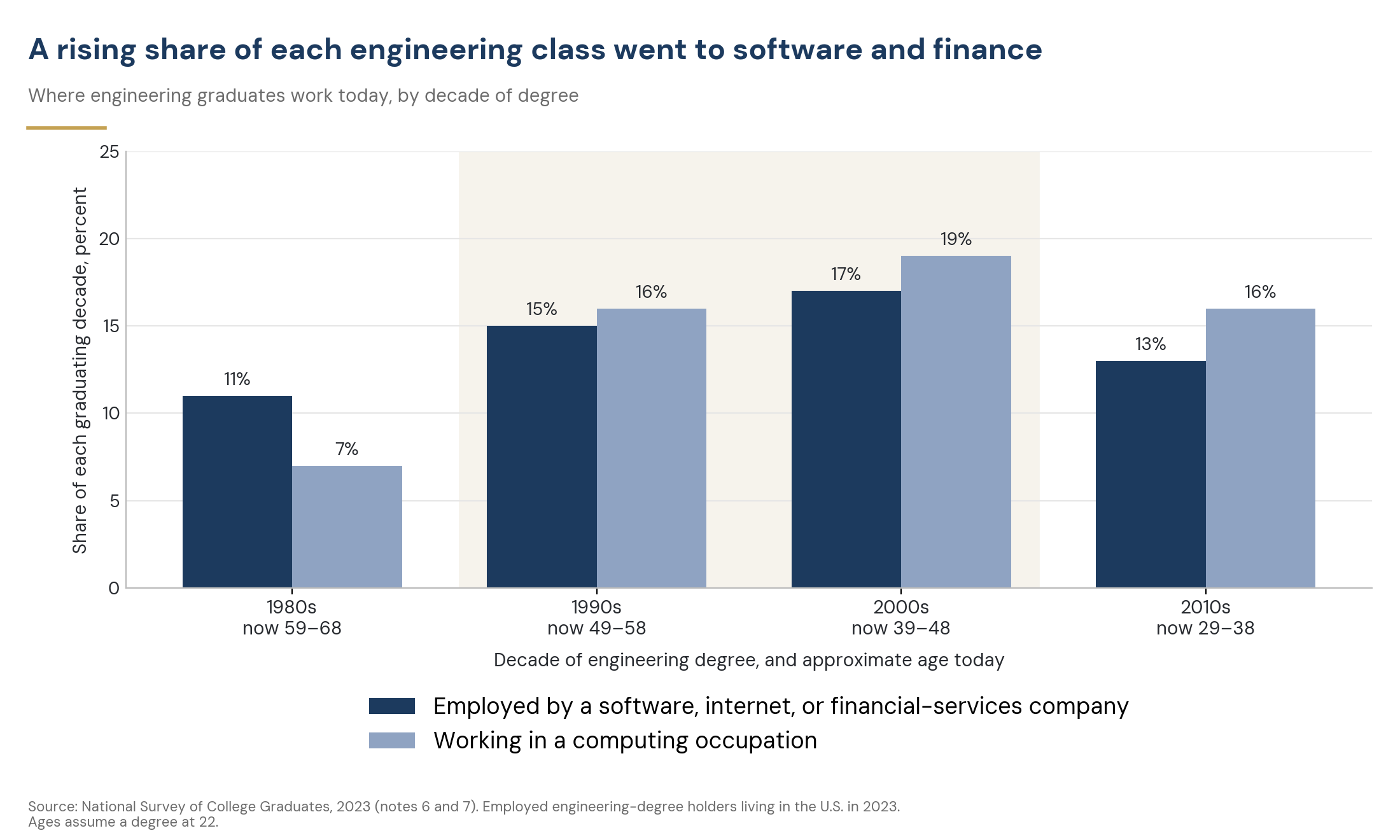
The turn is visible in the government’s own survey of college graduates, which asks people with an engineering degree where they work today.6
Conclusions:
- The share of engineering graduates who went to work for a software, internet, or financial-services company rose from 11 percent for the 1980s classes to 15 percent for the 1990s classes and 17 percent for the 2000s classes.
- The share working in a computing occupation rose faster: from 7 percent for the 1980s classes to 16 percent for the 1990s classes and 19 percent for the 2000s classes, more than double.7
- The 1990s and 2000s classes have the highest share. Those are the people who are 39 to 58 today. The Leadership Valley cohort graduated in the same years that hiring in software, internet, and finance was rising.
Why did they go? First, pay, and it was not the salary. In 2007, a new mechanical engineering graduate and a new computer engineering graduate were offered almost the same starting salary, and across the whole occupation the software engineer’s median salary in 2006 was only about 15 to 20 percent higher.8 On salary alone, a rep firm could compete. The difference was equity. A software company paid a 22-year-old engineer a salary and a share grant that could be worth more than years of pay. A rep firm could offer a commission plan that paid on what the graduate sold. A manufacturer could offer a salary and a pension. Neither could offer what the software company could: a chance to be paid like an owner before turning 30.
Second, speed. A software company could double its revenue, go public, or be acquired within a few years of hiring a graduate, and the graduate’s shares moved with it. A career selling mechanical equipment advanced on a timeline measured in decades. The fastest way to the top of a rep firm is to buy in, and a rep can only buy in when the owner decides to sell a share of ownership, which most owners do not do until they are planning their own retirement. The engineering graduate who went to a software company could have the biggest payday of a career at 28. The one who went to a rep firm might not get it until the owner is ready to leave.
Third, prestige. Through the 1990s and 2000s, classmates, professors, and parents expected ambitious engineering graduates to go to a technology company. Selling air-handling equipment to mechanical contractors, however well engineered the equipment and however good the money, did not carry that pull. Researchers tracking three generations of American students through the science and engineering pipeline found that the highest performers were leaving, drawn by higher pay outside their fields.9
Senior leaders in the rep channel saw the result from the other side of the interview table. Engineering graduates who a decade earlier would have talked to a rep firm were taking offers from technology and financial firms instead. That pipeline did not dry up; it was diverted.
The second cause:
A compensation structure built for selling and nothing else
The second cause is internal, and it is the one rep firms can control: how a rep firm pays its people. Most firms have two sales groups. The first sells to contractors. These are the high-ticket sales, and the people who make them are paid 100 percent on commission. The second is the inside sales engineering group that sells to the architects and engineers who write the specifications. That sale takes longer, so those engineers are paid a salary plus a commission, with the commission the smaller part of their pay. Both plans pay for what the individual sells or specifies. Neither pays anyone to coach a rep, forecast a territory, or develop a successor. A firm gets a sales manager only when an owner decides to create the role, and that decision is almost always forced by succession.
How many rep firms run a non-producing sales manager at all? No one has published the number for this channel. But a firm with the independent rep industry’s average of fewer than four salespeople, the MANA figure cited earlier, does not have a sales manager; it has an owner who sells. Twenty years on, principals in this channel put the share of HVAC rep firms with a dedicated sales manager at well under a third, and our own search work confirms it. The closest comparable industry shows the same neglect of leadership development: in insurance brokerage, the best-documented commission-based, relationship-driven channel, only 32 percent of firms have identified a future CEO or put a formal leadership development program in place.10 The same report finds that the top quarter of brokerage firms, ranked by organic growth, have a weighted average shareholder age of 43, against 54 for the average firm, and names leadership gaps — no second layer of management, key relationships held by one person — as a structural weakness that lowers buyer confidence.
The compensation structure is the reason the middle tier never formed, and it is also the instrument that fills it. Cause and cure are the same thing. That settles a question that comes up later: if the channel neither attracted nor developed its own leaders, then sourcing leadership from outside HVAC is not a workaround; it is the direct answer.
Why the Valley Persists
A firm without a middle tier has not just lost its future leaders; it has lost the mechanism that produces them. The middle tier is where development lives, and it lives there in two roles. The mid-level producer is who a junior watches: how a client is handled, why handling differs from client to client, and how product knowledge turns into product application. The mid-level sales manager does the deliberate work of developing every rep who needs developing. A firm with an empty middle has neither the example nor the coach, and the gap remains, for three reasons.
Development time cannot be shortened
A firm with no one in the middle has one place left to look when a senior rep’s accounts need a new owner: the young reps, aged 20 to 35. Developing one of them into a rep who can take a senior’s territory takes about five years, and nothing a firm does shortens that, because the clock is not the young rep’s; it is the buyer’s. Two things work against the younger rep, and neither is talent. The first is arithmetic: 10 years of selling cannot have seen what 25 years have seen. The second is perception: the people who choose HVAC systems for large projects have their own jobs on the line, and they default to the safe choice, which looks like the person who has been selling and supporting this equipment for 25 years. The only way to shorten the clock is to hire someone who has already put in the years.
The incentives work against you
Without compensation redesign, senior reps have a financial reason not to cooperate. In a commission-based business, introducing a junior rep to your best customer means sharing some portion of your income. Any transfer of relationships, however you structure it, depends on senior reps willingly sharing what they know and who they know. Without aligned incentives, you rely on goodwill and skills that were never theirs to begin with: your senior reps were trained to sell, not to train.
Leadership is a different skill
The sales manager role missing from the middle stays empty for a related reason. A sales manager is not a producer with a title. It is a different job that calls for different skills, and the structure of a selling career gives a producer almost no chance to build it. Becoming great at the sales side of this business takes years spent in front of engineers and contractors, learning equipment and learning accounts, and the compensation plan pays for exactly that and nothing else. Every hour spent developing someone else is an hour not spent on personal production, and the plan makes that trade expensive.
What’s at Stake
The consequences cascade
Without the fix, watch what your best young people see: seats above them held by seniors with no timetable and no reason to hand anything over; no one in the building to develop them; years of coaching spent uncoached. Bottom line: they cannot develop quickly, and they cannot develop fully. Your sharpest young people run this calculation first, and they are also the first to recognize a firm that has built the path. And if you have not built that path, your high-potentials are the ones gearing up to leave. Your senior people retire on their own schedule because there is no incentive to stay. The middle is thin everywhere in the channel, and the few mid-career professionals in it command a premium. Each departure makes the next one more likely. Firms that do not act will find the problem compounds rather than stabilizes.
Your line cards: the risk is asymmetric
If a manufacturer sees an aging team with no experienced successors in the pipeline, it will start exploring reassignment. It may not tell you it is doing so. By the time you find out, a competing rep firm may already be in conversations about taking your line. A lost line does not just reduce revenue; it reshapes the firm’s market position and can shake the confidence of the other manufacturers on the line card. It can be the event a rep firm struggles to recover from.
Line loss is the largest consequence of leaving the structure unaddressed, but not the only one; client defections and competitive decline arrive with it. All three are revenue events measured in millions. Solving the problem is measured in hundreds of thousands.
The Structural Fix: Two Solutions
The Valley has to be filled, and the fix has two parts, in a fixed order. The first is an Account Continuity Agreement that pays the senior rep to release accounts. The second is the hires that receive them: one or more people in the sales role, one in the sales manager role, or both, and if a firm cannot promote from within, it hires them from outside. The economics run in the owner’s favor: unlike most repairs, these show up in the firm’s value, often immediately. This section covers the Agreement first, then the sales rep hire, then the sales manager.
The giving side: compensation redesign
Compensation redesign is the foundation, and it must come first. Hiring a producer puts someone in place to receive the firm’s accounts; it does not make anyone willing to release them. Releasing an account has to build the senior rep’s retirement instead of shrinking their paycheck, and that takes not goodwill but an Account Continuity Agreement that sets out who is paid what, and when, as each account transfers.
It can be done, because two commission-based, relationship-driven industries already do it. In independent insurance brokerage, a retiring producer keeps a declining share of commissions on transferred accounts for a fixed term, after which the successor has all of it; formal transitions of that kind retain 93 percent of clients, compared with 82 percent for informal ones.11 In wealth management, the large brokerage houses pay a retiring advisor a multiple of trailing twelve-month revenue over five to seven years, financed mostly by the successor’s reduced share on the inherited accounts until the firm recovers most of what it paid.12 Both sides are paid to make the account continuity work; the firm underwrites the gap between them. Renewals and advisory fees are not rep commissions, so neither model transfers directly.
The adaptation rests on five principles:
- Base the schedule on the account’s trailing commissions rather than on renewals.
- Pay the retiring rep a declining share for a fixed term.
- Make the payout depend on the account’s retention.
- Have the firm bridge the first year, when the successor does most of the work for the smallest share.
- Require a phased schedule in which the retiring rep stays on calls for the first year or two with an explicit mentoring mandate.13
The working parts of the giving side are ordinary and few: client transition protocols, structured knowledge capture, and a clean CRM, so relationships live somewhere besides one person’s memory. They are components of the fix, not substitutes for it.
There is a recruiting dimension too: mid-career candidates read the compensation plan before they accept, and a plan that shows the firm has thought through how accounts change hands signals a well-run organization, one that thinks long term and values keeping its people.
When the senior rep is the owner
In most independents, the person holding the best accounts is not a senior employee. It is the owner. An owner’s compensation is the firm’s profit, so commission redesign does not reach the owner. The disincentive is different and harder: releasing those accounts is the last step before the person who built the business is no longer needed. That is the succession problem in an owner-operated rep firm, and it is probably the one most readers of this paper are living with.
The answer for an owner is not a commission share; it is the firm’s valuation. The accounts an owner transfers to a successor on a documented schedule are the accounts a buyer will pay for, because the buyer can see that they survive the owner’s departure. The accounts that stay with the owner until the day of departure are the ones a buyer discounts. For a senior employee, the Continuity Agreement pays that employee to release the relationship. For an owner, the same agreement determines what the firm is worth once the owner is gone. The size of that discount, and where it appears in the deal, is taken up later in this paper, under “What a Buyer Would See.”
The receiving side: the sales rep hire
Once the giving structure is right, you hire an experienced producer into the cohort aged 35 to 50: relationships, technical credibility, market knowledge, someone hired to carry accounts today. Three search strategies exist, and the urgency of your need will drive which one you deploy.
The three strategies and what they cost in time
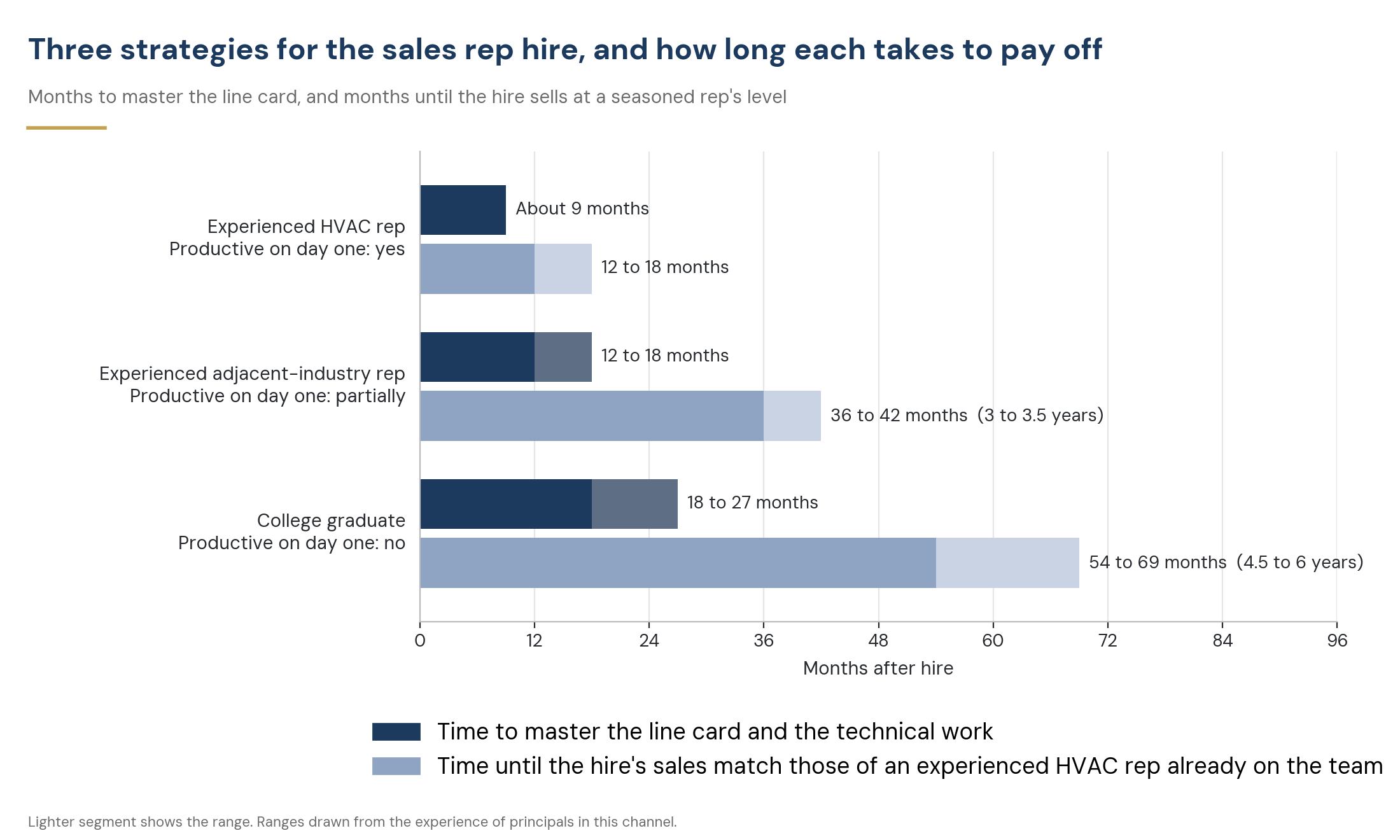
The following chart is drawn from the experience of principals in this channel. Every market differs, and the numbers are ranges, but the order and the gaps between the strategies hold.
The second bar for each strategy measures output, not pay. It is the point at which the hire’s book is producing commission revenue at the level of a seasoned rep on the same staff.
Conclusions:
- Experienced HVAC rep. Pro: productive on day one, and the shortest runway of the three. Con: supply. Every firm in the territory is looking at the same short list, and non-compete and non-solicitation agreements are standard in this channel, so every candidate must be asked whether they have one, and a move by a rep who does carries litigation risk that has to be managed with counsel. Firms take measured risk and make this hire anyway, and it is becoming more workable in states that have narrowed enforcement, but not enough of these people exist to fill the Valley in large numbers.
- Experienced adjacent-industry rep. Pro: the largest supply of candidates, and selling skill and a directory of who sits in which building arrive on day one. Con: product credibility and the mechanical-side relationships have to be rebuilt, which is why the runway is about three years. That is longer than an optimistic principal wants to hear, but it still beats developing a graduate by approximately two years.
- College graduate. Pro: available, and the firm shapes the rep from day one. Con: the longest runway, four and a half to six years, and the length is set by the customer and their confidence in the rep, not the graduate’s competency.
A rep from an adjacent channel can sell, but there are two things to learn: the line card, and who they are selling to. The firms are the same. The buyers are not.
Rep firms sell to mechanical engineers who specify, MEP consultants, architects who influence, mechanical contractors who select and buy, and facility managers who run the buildings. Electrical, plumbing, and controls reps sell into those same firms. A rep who spent years selling switchgear has sat in the same buildings on the same projects and brings general selling skill and a directory of names.
What does not transfer is the relationship. The electrical department at a large MEP consultant is not the mechanical department, and HVAC selection depends as much on application engineering depth as on access. Selling skill transfers; product credibility does not; relationships are rebuilt, not inherited. That is the trade.
Whichever strategy a firm favors, the search for the sales rep considers all three at once and is clear about each candidate’s runway and cost. This hire costs more in base, commission, and recruiting fees than the firm is used to paying, but it offsets its own cost.
The sales manager hire
The second role whose absence contributes to the Valley is the sales manager: the person who manages the entire sales team, including the senior producers, by riding with reps, coaching calls, and developing anyone who needs developing. Some firms already have this person in place. Many smaller firms do not have one and cannot afford one, so the owner or senior producers do the work themselves. When the role does not exist, filling it is simpler than the sales rep hire described above. The firm creates the position and hires someone into it. The only decision is whether to promote that person from within the firm or recruit them from outside.
For the sales manager, the outside hire is frequently the better candidate, not a compromise. The HVAC rep channel promotes its best producers into management and then asks them to do a job no one trained them for. A sales leader developed in another industry arrives with coaching, forecasting, territory management, and people development skills already built, because those are the things a sales organization outside this channel measures and rewards. The line card is learnable. Leadership capability is not, at least on any timeline that helps a firm in this decade.
The sales manager also makes the Continuity Agreements work. The senior rep and the successor are both salespeople, and a transfer between two salespeople needs a trained manager of salespeople to make it succeed. Someone has to make sure the introductions happen as agreed, hold the successor to the plan, step in when the senior rep drifts back to old customers, and report to the owner on whether the accounts are holding. That is management work, not selling, and in a firm with no sales manager, no one does it. The Continuity Agreement puts the transfer plan in writing; the sales manager is why the plan gets carried out.
Both hires draw from the same three sources: inside the HVAC rep channel, outside it, or developed within the firm. Each source delivers something different for a sales manager.
| Strategy | What arrives on day one | What has to be built | Supply |
|---|---|---|---|
| Sales manager from another HVAC rep firm | Coaching, forecasting, territory management, and people development, plus the products, the specifiers, and the manufacturers | Only the specific line card; months, not years | Limited, because most rep firms do not run a non-producing sales manager role; the non-compete cost also applies |
| Sales leader from outside HVAC | Coaching, forecasting, territory management, and people development, already measured and rewarded in the industry that trained them | The line card and the technical work: 12 to 18 months, the same as any outside hire | Large. Every industry with a professional sales organization produces these people |
| Producer promoted from inside the firm | The line card, the technical work, and the firm’s accounts | The management job itself: coaching, forecasting, territory management, and developing people, with no one in the building to teach it | Available, but promoting the best producer removes that producer from the accounts the firm most needs covered |
The outside leader is strong on what takes years to build and weak on what takes months; the promoted producer is the reverse, and no one is there to close the gap; the in-channel manager is best on both and hardest to find.
A note about succession
In an independently owned rep firm, the default was to pass management of the whole firm to the next generation. Sometimes that works. Handing the whole firm to one successor means handing them every job at once — sales leadership, operations, finance, manufacturer relationships. Nobody can do all of those jobs well right away, and the firm may not be able to afford the years it takes to master them. The Agreement and the mid-career hire make handing down survivable: the next generation inherits a firm with a middle, rather than one where they must be the middle.
What a Buyer Would See
One scenario remains, and leaving it undiscussed would mean not considering every alternative. For many of the independents this paper is written for, selling is not on the table and never will be; this section is not an argument for it. But the consequences in that scenario belong in any full accounting of the options.
Consolidation in the rep channel is real, and sophisticated acquirers are actively buying. Each one walks the house with a flashlight. The same bench manufacturers use to decide whether to keep their lines with you is what a buyer uses to decide what your firm is worth; if continuity of leadership is at the center of how manufacturers judge a rep firm’s future, a buyer is simply that judgment with a checkbook.
Here is what anyone who has sold a house with a bad roof already knows: the price does not drop by the cost of the roof. It drops by the cost of the roof, plus the buyer’s inconvenience of managing the replacement, plus a discount for the unknown, because until the roof comes off, nobody knows whether the rafters underneath are rotted too. Buyers always over-discount for what they cannot see. That is why selling a fixer-upper costs you: the haircut is reliably larger than the repair would have been. One deferred repair devalues the whole property.
The same logic applies to a rep firm. The buyer prices the leadership, the structure that exists and the gaps where it does not, and the largest part of that price is the unknown: nobody, including you, knows which relationships survive the seniors’ departures until they depart. The discount shows up as a lower price, a longer earnout, and more of the deal contingent on you personally staying. What a sale actually involves — who the buyer is, what you take, and when — is the subject of a separate Talent Inroads paper, What Forty Years of Platform Plays Predict About HVAC Rep Consolidation (forthcoming, fall 2026).
The three discounts on the house are the three discounts on the firm. The cost of the roof is the lower price. The inconvenience of managing the replacement is the longer earnout. The unknown under the roof is the money held back until you have stayed long enough to prove the relationships survive without you. A firm with successors already in place answers all three at once, and prices and sells accordingly.
Whatever you ultimately choose, the same work increases the value of every option in front of you. The only expensive decision is deferring the work until a sale is forced, and taking the fixer-upper price for a firm that was worth far more.
The Investment and the Return
The HVAC manufacturers’ rep industry has something genuinely valuable: deep, trust-based relationships that take decades to build and cannot be replicated by technology, marketing, or scale. Those relationships are the reason the business works. They are the bones of the house, and the house is in good shape.
The question is the roof: who carries these relationships next. It has waited long enough that what’s accumulating beneath it can no longer be inspected from the ground. The owner can keep deferring and hope the accounts survive the senior rep’s departure, or replace the roof now: put an Account Continuity Agreement in place so the senior rep is paid to release accounts, make the needed hires — sales rep, sales manager, or both — and let the years that remain work in the firm’s favor instead of against it.
The house was never the question. It holds everything you’ve put into it. The question is one investment: make the fix, and the firm is stronger. Hand it down, and it is a legacy you can be proud to give. Decide to sell, and it commands its full price. On every path, the return exceeds the cost of the fix.
Notes
1. National Electrical Manufacturers Representatives Association (NEMRA), 2025 Rep of the Future Report: Vision 2030 (September 2025). Findings on aging rep firm leadership, the decline in independent rep firm formation, a projection of 25 percent fewer independent rep firms by 2030, and manufacturers’ emphasis on continuity and succession. Based on interviews with 50+ manufacturers and independent representatives. nemra.org.
2. Association of Independent Manufacturers’/Representatives (AIM/R). Succession planning programming and the Leaders of Tomorrow... Today (LOT/T) next-generation leadership initiative. aimr.net.
3. Manufacturers’ Agents National Association (MANA), Agency Profile Survey, published as “An Updated Profile of the Manufacturers’ Sales Agency,” Agency Sales magazine, August 2005, pp. 6–12. Principal Owner’s Profile chart, p. 7: average owner age 55 years. Sales Agency Profile chart, p. 7: average of 3.9 salespeople per agency, including the owner. Same chart, plans for the continuity of the agency: 40 percent report no immediate plans or dissolution upon retirement, stated in the narrative (p. 11) as no succession plans. MANA states that the article reports responses from members, that not all members participated, and that it should not be considered a scientifically based survey. manaonline.org.
4. National Center for Education Statistics, Digest of Education Statistics 2023, Table 322.10, Bachelor’s degrees conferred by postsecondary institutions, by field of study, selected academic years 1970–71 through 2021–22. Engineering bachelor’s degrees conferred: 62,448 in 1990–91; 62,168 in 1995–96; 58,209 in 2000–01; 66,841 in 2005–06; 123,017 in 2021–22. Figures are for engineering only and exclude engineering technologies, reported separately in the same table. nces.ed.gov.
5. Paul Kedrosky and Dane Stangler, Financialization and Its Entrepreneurial Consequences, Ewing Marion Kauffman Foundation, March 2011, citing MIT Career Office placement data and Thomas Philippon and Ariell Reshef, “Wages and Human Capital in the U.S. Financial Industry: 1909–2006.” kauffman.org.
6. National Center for Science and Engineering Statistics, National Survey of College Graduates, 2023, tabulated through the NCSES Table Builder (ncsesdata.nsf.gov/builder/nscg). Filters: survey year 2023; field of highest degree, major group = Engineering; rows = year of highest degree, five-year intervals; columns = Census industry code for employer. Shares are of employed respondents, excluding those with no occupation recorded. “Software and internet” combines software publishers, internet publishing and web search portals, data processing and hosting, and computer systems design services; “financial services” combines banking, savings institutions, nondepository credit, and securities and funds. Groupings are the authors’. The survey counts people living in the United States in 2023, so it includes those who earned degrees abroad; “year of highest degree” counts a later master’s in its own year.
7. Same source, columns = Occupation, minor group (2023). “Computing” combines computer and information scientists, mathematical scientists, and postsecondary teachers of those fields.
8. U.S. Bureau of Labor Statistics, Occupational Outlook Handbook, 2008–09 edition. Computer Software Engineers statement: median annual earnings, May 2006, computer applications software engineers $79,780, computer systems software engineers $85,370; starting salary offers to bachelor’s graduates in computer engineering, 2007, per the National Association of Colleges and Employers, $56,201. Engineers statement: median annual earnings, May 2006, mechanical engineers $69,850 (Table 2); average starting salary, bachelor’s degree in mechanical engineering, 2007, per the National Association of Colleges and Employers, $54,128 (Table 3). Archived at fraser.stlouisfed.org.
9. B. Lindsay Lowell, Harold Salzman, Hamutal Bernstein, and Everett Henderson, “Steady as She Goes? Three Generations of Students through the Science and Engineering Pipeline,” paper presented at the Annual Meetings of the Association for Public Policy Analysis and Management, Washington, DC, November 5–7, 2009. Rutgers University and Georgetown University; funded by the Alfred P. Sloan Foundation. doi.org/10.7282/T31R6S4K.
10. MarshBerry, “The Top Six Obstacles to Perpetuation Planning and How to Overcome Them,” by Jennifer McKay, May 28, 2026, reporting findings from MarshBerry’s 2026 Technology & Governance Report: 59 percent of insurance brokerage firms have a defined plan to transition retiring producers’ books; 32 percent have identified a future CEO or implemented a formal leadership development program. The same article reports, from MarshBerry’s Perspectives for High Performance data, a weighted average shareholder age of 43.2 years for the top 25 percent of firms by organic growth, compared with 53.9 for the average firm. marshberry.com.
11. Independent Insurance Agents & Brokers of America (IIABA): a 2023 IIABA report found 88 percent of books retained 85 percent or more of revenue when the retiring producer assisted the transfer for six to twelve months; Reagan Consulting, 2024 Agency Universe Study: formal retirement transitions averaged 93 percent client retention versus 82 percent for ad hoc transfers; producer vesting and book-transition compensation structures per IIABA Virtual University, “Producer Compensation: A Base/Growth Model.” independentagent.com; reaganconsulting.com.
12. Merrill Lynch Client Transition Program, as reported from the firm’s advisor memo in Financial Planning, “Merrill Lynch offers retiring financial advisors a pay raise” (May 2021), and in AdvisorHub coverage of the same program: awards calculated as a percentage of the retiring advisor’s trailing twelve-month revenue and scaled by production tier; a payout term of five years, extending to seven for the largest producers; funded by a reduced credit to the inheriting advisor on the transferred book until the firm recovers a set share of the award. Snowden Lane Partners, “Practice Continuation Plan” (press release, December 2024), describes a comparable structure at an independent firm. financial-planning.com; advisorhub.com; businesswire.com.
13. U.S. Office of Personnel Management, Phased Retirement: final regulations published August 8, 2014, effective November 6, 2014; participants work part time and must devote 20 percent of their schedule to mentoring and knowledge transfer; OPM describes the program as a succession planning tool. opm.gov (Phased Retirement FAQ and August 8, 2014 news release).
About the Authors
Julie Davidson is a Partner of Talent Inroads, with nearly three decades in retained leadership search, including co-founding the North America Software and Technology practice at a global search firm.
Martha Janssen is Managing Partner of Talent Inroads. She brings nearly thirty years in manufacturing search, the last ten focused largely on the HVAC channel, where she has completed more than 80 retained leadership searches for manufacturers and manufacturers’ rep firms.
Talent Inroads is a leadership search firm serving HVAC manufacturers’ rep firms and the manufacturers they represent.
talentinroads.com · © 2026 Talent Inroads, LLC
Prefer a copy to print, save, or share with a partner? Enter your name and email and the PDF is yours.