
The HVAC manufacturers' rep channel is missing a generation, and the gap is not any owner's mismanagement. What the gap is, and the question manufacturers are asking about it, is in The Question Every Manufacturer Is Asking About Your Rep Firm. Of the Valley's two causes, the first is external, and it is visible in the government's own data.
Every industry that hires engineers draws from the same pipeline. When the Leadership Valley cohort was graduating, that pipeline produced about 60,000 engineering bachelor's degrees a year. Today it produces roughly 120,000. Rep firms have always drawn from it in small numbers, hiring the graduate who could read a spec and sit across from a design engineer as an equal. That pipeline did not dry up. It did something harder to see. Starting in the mid-1990s, a growing share of it turned toward two industries that had not competed for these graduates before: finance and software, first through Wall Street's demand for quantitative talent and then through the technology and financial-technology companies that followed.
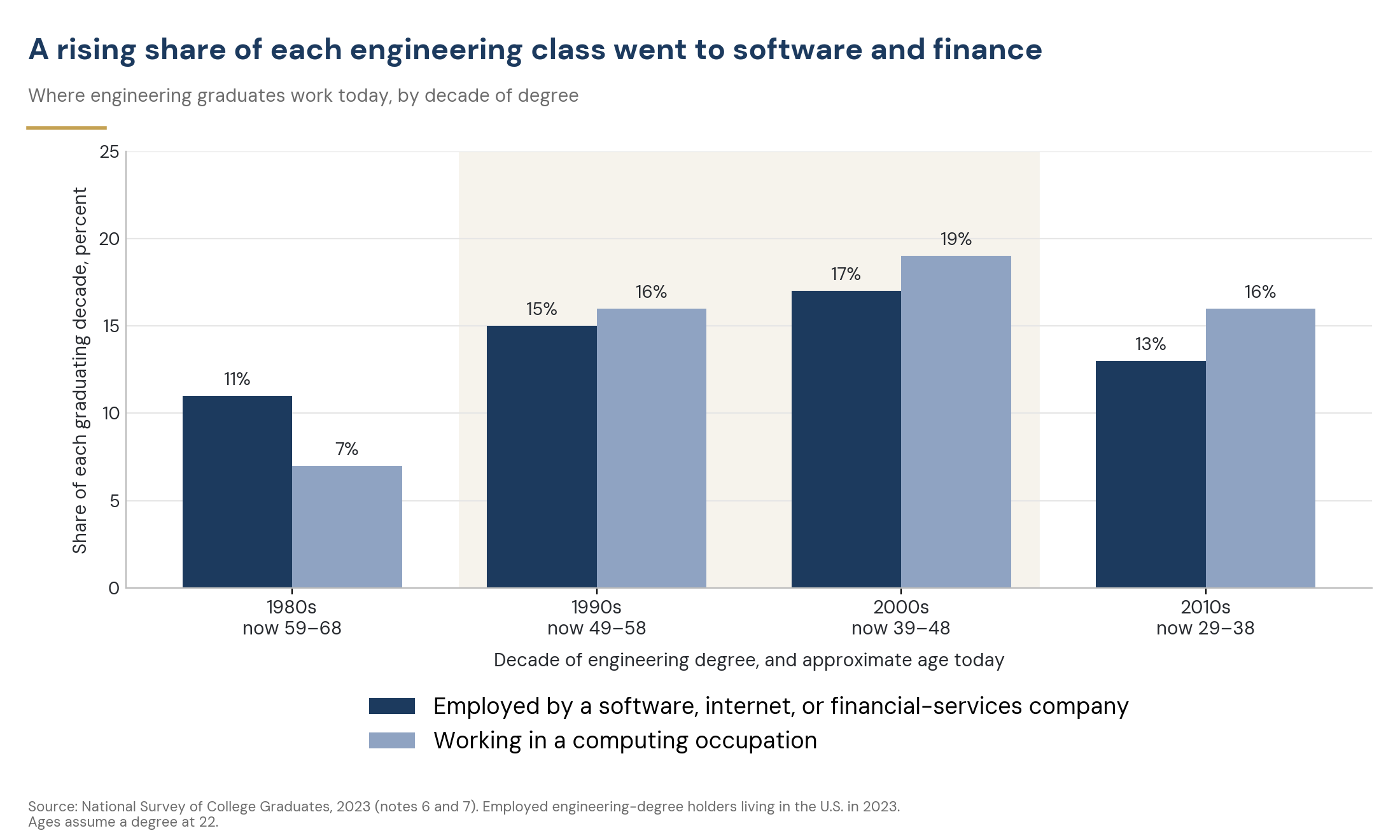
The turn is visible in the government's own survey of college graduates, which asks people with an engineering degree where they work today.
Conclusions:
- The share of engineering graduates who went to work for a software, internet, or financial-services company rose from 11 percent for the 1980s classes to 15 percent for the 1990s classes and 17 percent for the 2000s classes.
- The share working in a computing occupation rose faster: from 7 percent for the 1980s classes to 16 percent for the 1990s classes and 19 percent for the 2000s classes, more than double.
- The 1990s and 2000s classes have the highest share. Those are the people who are 39 to 58 today. The Leadership Valley cohort graduated in the same years that hiring in software, internet, and finance was rising.
Why did they go? First, pay, and it was not the salary. In 2007, a new mechanical engineering graduate and a new computer engineering graduate were offered almost the same starting salary, and across the whole occupation the software engineer's median salary in 2006 was only about 15 to 20 percent higher. On salary alone, a rep firm could compete. The difference was equity. A software company paid a 22-year-old engineer a salary and a share grant that could be worth more than years of pay. A rep firm could offer a commission plan that paid on what the graduate sold. A manufacturer could offer a salary and a pension. Neither could offer what the software company could: a chance to be paid like an owner before turning 30.
Second, speed. A software company could double its revenue, go public, or be acquired within a few years of hiring a graduate, and the graduate's shares moved with it. A career selling mechanical equipment advanced on a timeline measured in decades. The fastest way to the top of a rep firm is to buy in, and a rep can only buy in when the owner decides to sell a share of ownership, which most owners do not do until they are planning their own retirement. The engineering graduate who went to a software company could have the biggest payday of a career at 28. The one who went to a rep firm might not get it until the owner is ready to leave.
Third, prestige. Through the 1990s and 2000s, classmates, professors, and parents expected ambitious engineering graduates to go to a technology company. Selling air-handling equipment to mechanical contractors, however well engineered the equipment and however good the money, did not carry that pull. Researchers tracking three generations of American students through the science and engineering pipeline found that the highest performers were leaving, drawn by higher pay outside their fields.
Senior leaders in the rep channel saw the result from the other side of the interview table. Engineering graduates who a decade earlier would have talked to a rep firm were taking offers from technology and financial firms instead. That pipeline did not dry up; it was diverted.
The second cause is internal, and it is the one rep firms control: where salespeople are on 100 percent commission, the firm pays for individual production and for nothing else, so it never produces a sales manager by accident. The channel neither attracted its share of a generation nor developed leaders from the share it did attract. What that gap costs a rep firm when it is left alone is in What It Costs a Rep Firm When the Bench Is Thin.
Sources: National Center for Education Statistics, Digest of Education Statistics 2023, Table 322.10; National Survey of College Graduates, 2023; U.S. Bureau of Labor Statistics, Occupational Outlook Handbook, 2008–09; Lowell, Salzman, Bernstein, and Henderson, "Steady as She Goes?" (2009). Full citations are in the paper.
This is an excerpt from The Leadership Valley, the Talent Inroads white paper on workforce succession in the HVAC manufacturers' rep channel. Read the full paper.